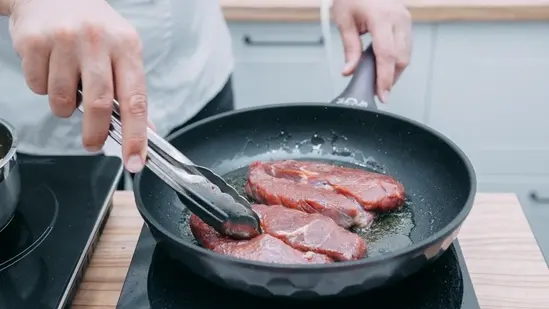
Hepatologist shares healthy way to cook meats to reduce risk of cancer and fatty liver: ‘High, dry heat is the enemy’

Dr Cyriac Abby Philips, MD (internal medicine), DM (hepatology and transplant medicine) and popularly known as The Liver Doc on social media, took to Instagram on June 10 to explain the healthy way to cook meat to reduce the risk of cancer and fatty liver.
Also Read | Gastroenterologist shares 3 foods he eats every morning for gut and liver health: Berries to black coffee
What happens when you cook meat incorrectly?
According to Dr Philips, heterocyclic amines (HCAs) are a family of nitrogen-containing compounds produced when the creatine/creatinine in meat muscle reacts with free amino acids and sugars in the Maillard “browning” reaction once surface temperatures exceed roughly 150 degrees Celsius. These HCAs are carcinogenic, meaning they can increase the risk of the development of various cancers.
The best way to cook meat
So, what could be the correct way to cook meat so that you can reduce the risk of fatty liver and various cancers? Per the hepatologist, turn the heat down and add moisture.
High, dry heat is the enemy: He explained that the hotter and drier the surface, the more HCAs, poly-cyclic aromatic hydrocarbons (PAHs) and advanced glycation end-products (AGEs) you create.
Moreover, the latest scientific data confirms that steaming, poaching, braising, pressure-cooking, and sous-vide style meat cooking generate the lowest load of toxins, while still killing pathogens. “Sous-vide plus a quick sear is the gold standard for flavour with minimal damage,” he said.
Additionally, he stressed that sous-vide is a better cooking method than pan-frying or tandoor cooking. He suggested holding poultry at 62-65 degrees Celsius or red meat at 55-60 degrees Celsius for one to four hours under vacuum, as it destroys Salmonella and E. coli while slashing total HCA formation. Then, finish with a 30-second sear (a method where the surface of the meat is rapidly cooked at high heat) for flavour.
What if you want to grill or barbecue the meat?
Dr Philips suggested a few tips:
1. Marinate hard
He suggested marinating the meat with acid + antioxidants, which is vinegar or lime + turmeric, garlic, ginger, rosemary, thyme. This cuts HCAs by 60-90 percent.
“Indian spice mixes already pack antioxidant polyphenols that absorb free radicals forming in the pan,” he added.
2. Microwave first
Two minutes in the microwave drains creatine-rich drippings and removes 90 percent of would-be HCAS.
3. Flip often, keep the fat off the flames, and trim the black crust
Charred patches and fat-fuelled flare-ups drive PAH formation.
4. Indirect cooking
Grill away from direct flame or use a raised rack; this reduces temperatures that form HCA/PAH.
Lastly, the hepatologist advised meat eaters to skip cooking in a deep fryer as deep-frying the meat at 180-190 degrees Celsius bathes it in oxidising oil. Meanwhile, he said that air-frying is only a partial upgrade. Instead, he suggested reserving deep-frying or air frying meat for once every two weeks.

Comments are closed.